.
I SHALL CLOSE IN THE PRIMEVAL FOREST
I shall close, then, under Ferntrees
of the Primaeval Forest
Beyond Warburton,
back in the late eighteen nineties
When I lugged my full pack
walking out to the goldmines
Alone up The Yarra Track and into
that Ancient Quietness.
At day’s end I was brought up to
a foreshortened pause
By the hot hot day’s ever so slow,
uncool withdrawal;
Alone under the tall vertigo of Mountain Ash trees,
high and formal,
Down which their bark’s suit-tails curled,
curled in claws.
I camped at a derelict hut, a sort
of deserted mia-mia,
Right by water under speckle stars
framed high-up by trees;
And fell to my own tramp of the feet
that wouldn’t cease
in long wake-dreams, the mopoke owl-tolls
of ancient fire.
Night went weird as Walsh’s Creek
jumped its gurgles down
I went over and over the dreamless
moss-strewn log and boulder;
Knowing the undergrowth guarded something
in it’s shoulder
As sleep held back the still-peace
in a restless nightgown.
As if by the music of the creek
in accompanying the wind
My helplessness increased, my insignificance
grew louder.
That mopoke tore my soul to ashes,
reducing me to powder
As the giant trees lashed the stars
and the half-moon grinned.
I saw the Goliath trees, great Eucalyptus Regnans
queens and kings
Stand as Egyptian armies marched warhorses
out against the Persians;
Watched far off Babylon fall, saw Alexander
take Asia on Excursion
While this great Primeval forest merely danced
its sways and swings.
I saw first Sphinx stones laid, as the platypus
dived for fernroot worms
Watch as a few nomad Aramaeans far wander’d for
a distant place to be;
And Magellan up a tall ship’s crows nest, decry
land from waves high at sea
As I writhed of the jeopardy beneath it all -
though the earth stayed firm.
I woke at last to the diffuse sunrise of wren-scold
and butcher birdsong
As I re-launched my load to live or die, my feet
took the mountain track;
As the layered old land pried open, the primeval worlds
kept falling back
Black cockatoos watched me go, to the solemn
tolling of a Currawong.
1 June 2009 © Wayne David Knoll
Based on the ‘Reminiscences of The Upper Yarra’ by W. J. EWART, a Series commencing in the ‘Warburton Mail’ 24 august 1934 - reprinted in ‘Warburton Ways’ by Earle Parkinson, 1984
Monday, October 26, 2009

Tuesday, February 27, 2007
In the Wild Goodwill of Unintelligible Poetries
[ Exchanging for the Stranger ]
- Moorabool Area, north of Geelong, Victoria 1839
-Mrs Katherine Kirkland reports on her 1839 accommodation and settlement in becoming an Australian Lady, with her old acquaintance Mr Yuille and in sharing culture with the Wadthawurrung people.
All horizons swung into Port Phillip as our vessel,
of England, sheered time and distance into our arrival.
‘Point Henry’ was our solid rock of disembarkation
But even then, familiarity went out of recognition.
My husband, come back on board from ‘Jillong’ in wild trust,
said he’d met Mr Yuille, a human anchor among steps of danger;
But, our friend -who’d left England just months before us -
now amazed me, appearing before me as a complete stranger.
Red whiskers that he’d let go, made a great long beard;
his countenance was now entirely outlandish! And I feared
for any safety when I saw the broad black belt he now wore
fastened his waist, stuck with a brace of shiny pistols. Ashore,
in dread of strangeness I asked about his rough-looking dress.
Mr Yuille tapped a gun: ‘Not natives, No! - Rogues, thieves!’
Then, looking about, I saw all men of the settlement, as in a fable,
[to toughen], took pride to deliberately look as rough as possible.
I myself began, two days later, and thirty miles upcountry,
to be of such a difference. The unaccountably-distanced spaces
meant rest for our bullocks, I had to tramp afoot to Russell’s station
where we found the natives who made fuss of us & put on a corrobery.
About a hundred of these disarmed sable folk assembled
as the sun went down, with twenty large fires lighted,
around which were seated the women and children, -
it was they embraced me, asking to sit with them, their fashion.
Men painted themselves up, as their customed fancy,
in red and white earth, with bones & bits of stones tied
with emu’s feathers in their hair. Branches of trees applied
on their ankles, made a great rush-of-wind noise as they danced.
Rough dress: theirs was next to nothing! In countenance wild,
they danced with awful gestures and savage attitudes
of a melodrama done in the high mettle of theatric feuds.
Yet done, each man after sat calm, cross-legged as a child.
The natives now were very anxious that we white people
would show them how we usually coroberie or sing;
but of all among us, it was only good-bearded Mr Yuille
who got up to dance for them - and did the Highland fling.
Then () he unbelted his pistol-belt, to recite epic poetry,
with full bodied expression ~ He made great many gestures.
The natives, spellbound, watched him most attentively. He
saved the day for us with a song of words, and they: highly pleased
as if they got a gist. After that linguistic exchange of native pleasure,
I saw a passionate reciprocity come full of disarming welcome,
I glimpsed this poetry, in a stranger-trust into which I am come:
and asked to belong, across far-frontiers by any other measure.
Outlandish, Mr Yuille bridged things, taught us, saved our side
turned in the welcome to lands of good-will with a gift of poetry;
For all his tough-looking in its passion, it was his rendition did;
A hoary magnificence that exchanged, crossed to change the story.
29 November 2001 © Wayne David Knoll
In Early Time - the Scoffing was at Rationalism
In Early Time
the Scoffing was at Rationalism
(set in Central Australia, early 20th Century)
We went north-west - through mulga
scrub, in the red centre’s sturdy ironwoods,
to camp on a grey Umberla plain.
Next morning, as we boiled billy
in early time, we became entranced
looking about Central Mt Wedge,
as - in cold frosty air - a mirage came
onto the horizon so that distant blue
mountains rose into air,
magnified, came so near us, we
could plainly discern rocks, ravines
and trees. Rationalising this
strange phenomenon, we were
scoffed at, by the practical desert
tribesman who was with us, for he
in learned patience, explained those
things were works of “Ngunta fairy folk”
who lived in those mountains.
-obviously, by dancing in cold dawn,
these beings - with their magic songs
- lifted these hills into the sky,
and, as sun rose closer to heaven,
they lowered them back once more
on to the tribal lands.
And we, entering into this geography, woke
a little to a listening that filled another day
with vistas of likely epiphanies all about us.
4 May 2001 © Wayne David Knoll
Based on a true account by W.B. (Bill) Harney
in "Life Among The Aborigines"
- 1957 [Robert Hale Ltd] pp 207
Thursday, February 22, 2007
The Frontier Temptation
The Frontier Occupation
A frontier is temptation.
At the edges
We are not what we were.
After adventuring, whaling,
After the black-sheep trail,
We come to a final court:
And say:
“When we found
ourselves at the edge
of the universe
we did different things
things we would not have done
at home,
Yet, before we lost ourselves
by leaving,
before we gave in
to the desire over the range,
came the dreams
of the stone pillow;
call it Jacob’s ladder:
was it for Up
or Down?
In the desert, in savage lands,
Among the aborigines, indigines
beyond the land of attitude,
we faced the test, the trial.
Did we desert? Lock up or in?
Did we lapse and
become savage?
Some,
sometimes, dizzy as drunks
we walked that edge, that line
was not painted, there was
not any paved road!
Did we kill the aliens
Before they did us?
at the edge,
it was there?
Occasionally,
We found what we truly
Believed, our own edge
Or lack of it,
I saw a few.
I glimpsed
into one.
It was
when we allowed
the brink
of the universe to tilt,
like pouring
beer from a jug into the glass
of us
over the edge, into the
run we have always been
waiting an opportunity
to slide,
or else
to find the sharp stance,
the moral fibre,
the gift of right
that finds brink-landings
to stand upon,
and refuses,
however tempting,
to turn those visionary
pillow stones
to fill our starving belly
in a fresh bakery
of warm loaves.
But being not so yet
we ate
and were pleased
and only sometimes
and long afterwards
sorry by amounts
we cannot put in
a tax return.
23 October 2003 © Wayne David Knoll
The Cascades, StonyCreek, Monbulk, Victoria
Wednesday, February 21, 2007
White Lady In A Boat
Katherine Coolibah
[ Aboriginal people in the Northern Territory ask in bottleshops for "white lady in a boat" - four litre cardboard casks of Coolibah brand Moselle - which they drink out of enamel metal mugs in any shadows made between two cultures. ]
White Lady In A Boat
Katherine coolibah, O Coolibah Katherine!
White lady of the white stream white money flows.
Coolibah we love you. But do you love us in return?
For every boat we get on is soon sinking down below?
You painted that picture like our lily ponds on a stream
On unsplit sides of ‘Chateau Cardboard’ casks of wine
As us blackfellas gather on payday in the deep shadows
of the leaves, drinkin’ under mango tree in white gardens
for a white lady in the boat who comes sailing cool and green
Katherine coolibah, O Coolibah Katherine!
White lady of the white stream the money flows.
Coolibah we love you. Do you love us in return?
Ya’ river is a hot an' thirsty highway in our mind
Moselle’s a white river under parasols to stop the sun above,
Washing dust to drown fairytales by the litres on the tongue.
Sittin’ daylight out, up pub steps as if sipping shade: a traffic
of passing, waiting for the liquor to shut every store of hope
for a white boat that comes for us when we are blind.
Katherine coolibah. O Coolibah Katherine
We just follow the White Lady of the stream;
We love you White Lady in a boat. Do you love us in return?
For each boat we board keeps sinkin’ in drowning dreams.
Wayne David Knoll © Late October 1995 Katherine N.T.
In Praise of Professor Eel Spear
[ Requiem for Weerat Kuyuut ]
( From the Mortlake district of Western Victoria, comes this portrait of Weerat Kuyuut -a friend and cultural informant to James 'Jimmy' Dawson, -who used what he could get from Eel Spear to write his colonial monograph ‘ The Aborigines of Victoria’, the Scottish-Australian pioneer, James Dawson, called Weerat Kuyuut (Eel Spear) ‘a professor of languages, geography and astronomy’.)
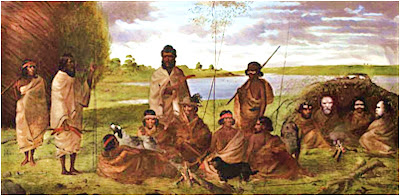
In Praise of Professor Eel Spear
He dust-sits, a dark old man, cross-legged, keen, it
Is his hands talk, pink and brown scissoring-fingers
translating the south-of-knowledge stars, then soft-palate
words pick the air of cosmologies, an astrology of
the lost magi, that knows a sky as a text of geography
ofbeginnings, the making stories he is a professor of .
Unheard-of languages, lost geography and astronomy -
Of ancient lava words roll grassed volcanic plains,
Mirranatwa karabeal, willatook, noorat,
south, his Grampians word is his Gariwerd,
tjerinallum naringal woorndoo minjah.
Professor Eel Spear sits no ivory tower, no rostrum
Oak, but she-oaks. Field knowledge is his passport,
his visa across enemy borders, as hair flies to shield
his balding pate, it fences what is understood,
a knowing of mysteries that goes off the sky,
he tells what he can of this to the one interested
white fella, but even ‘Djim Dawjon’ has stone ears
for most language, most country, Kuyuut must learn
English, telling of untold skies as storied meanings
lapse, then one after the other, as countrymen do,
they fall off the earth, as a bush professor always
tumbles down ignorance, the theory, specialising,
that does not begin to wait for answering songs
sung to link earth and sky, man and destiny...
as clued rhythms of sparely read tracks in earth
take footsteps which go out between the stars.
December 1999 © Wayne David Knoll

( From the Mortlake district of Western Victoria, comes this portrait of Weerat Kuyuut -a friend and cultural informant to James 'Jimmy' Dawson, -who used what he could get from Eel Spear to write his colonial monograph ‘ The Aborigines of Victoria’, the Scottish-Australian pioneer, James Dawson, called Weerat Kuyuut (Eel Spear) ‘a professor of languages, geography and astronomy’.)

PAINTING: Minjah in the Old Time (Weerat Kuyuut and the Mopor people, Spring Creek, Victoria) 1856 oil on canvas - 52.0 (h) x 108.5 (w) cm Held by University of Queensland, Brisbane. , Gift of Miss Marjorie Dowling 1952
Artist: Robert DOWLING: - England 1827 – England 1886 - Australia 1834-1857, 1884-1886
Weerat Kuyuut and the Mopor people includes the same participants as those in Minjah in the Old Time, with some additional figures: Wombeet Tuulawarn, husband of Yarruum Parpurr Tarneen, stands behind his wife. The site is likely to be the now drained Maramook Swamp, some six kilometres west of the Minjah homestead, and a place of cultural significance to the Mopor people. As with Minjah in the Old Time, Dowling based this work on his own detailed oil portraits of the participants. - This Artwork is now on show at The National Gallery.
In Praise of Professor Eel Spear
He dust-sits, a dark old man, cross-legged, keen, it
Is his hands talk, pink and brown scissoring-fingers
translating the south-of-knowledge stars, then soft-palate
words pick the air of cosmologies, an astrology of
the lost magi, that knows a sky as a text of geography
ofbeginnings, the making stories he is a professor of .
Unheard-of languages, lost geography and astronomy -
Of ancient lava words roll grassed volcanic plains,
Mirranatwa karabeal, willatook, noorat,
south, his Grampians word is his Gariwerd,
tjerinallum naringal woorndoo minjah.
Professor Eel Spear sits no ivory tower, no rostrum
Oak, but she-oaks. Field knowledge is his passport,
his visa across enemy borders, as hair flies to shield
his balding pate, it fences what is understood,
a knowing of mysteries that goes off the sky,
he tells what he can of this to the one interested
white fella, but even ‘Djim Dawjon’ has stone ears
for most language, most country, Kuyuut must learn
English, telling of untold skies as storied meanings
lapse, then one after the other, as countrymen do,
they fall off the earth, as a bush professor always
tumbles down ignorance, the theory, specialising,
that does not begin to wait for answering songs
sung to link earth and sky, man and destiny...
as clued rhythms of sparely read tracks in earth
take footsteps which go out between the stars.
December 1999 © Wayne David Knoll

Tuesday, February 20, 2007
In Days of Omen and Prophecy
Two Headed Mindi in the Hunt
~ Nullemengobeed, out of Bannockburn, north of Geelong, circa 1820-30
Omen of the Mindi Snake killed in a Hunt at Nullemengobeed, near Geelong, circa 1828
The Mindi is the double headed snake, or avenging spirit of the Kulin people. It could breathe out fire, and travel enormous distances, often stretching itself over the horizon from coil-gripped trees. It was seen as some sort of ultimate bringer of final truth in the form of punishment or tough justice. It was said to have brought the smallpox which affected or killed many aborigines. The smallpox scars were even called ‘scales of the Mindi’. It is said to have had its home near Mt Buckrabunyal, at the edge of the Victorian Mallee near Charlton.
“ I should here observe, that the natives sometimes, and when the wind is favourable, hunt round a kind of circle, into which they force every kind of animal and reptile to be found; they then fire the boundary, and so kill them for food; it matters not what they are, whether kangaroo, wombats, opossums, or black snakes; they are to them, with the exception of the last named, all alike; as are also lizards, toads, rats, mice, and wild dogs; they cook and eat them all. On one of these burning excursions, I remember a monster snake was killed, having two distinct heads, separating about two inches from the body, black on the back, with a brownish yellow belly, and red spots all over. It had been about nine feet long, but the fire had burnt the body in two, and being such an unnatural looking monster, the natives were terribly frightened at its appearance. Of the poisonous snakes generally, they are not the least afraid, for they eat them, after cutting off the heads, and roasting them in the usual manner.’ pp 96
William Buckley/John Morgan - The Life and Adventures of William Buckley 1852
In Days of Omen and Prophecy
We thought the change was a favourable wind
and us commanding the fire circle got it to ring,
focussing back down with us in our narrowed breadline
where our Wadthawurrung hunters killed everything.
Big Buckley was one of us by then, no two ways
about it; all the animals, fear-singed by the flame
went to our fire-free boundary gap, as culture playing
our redbeast across the elements united them tame.
There was never mere snake-fear among us back then,
snake roasted like eel, the poison - cut off with the head -
went long before seduction tempted knowing-death in men,
- no enlightened viper ever chanced a say on what we fed.
Kangaroos, wombats and possum: these were tucker.
Rats, reptiles, lizards and black snakes: a provident haul.
But then, in that cultural afternoon, the fire drew a monster
of a snake, it naturally frightened us terribly, he saw it all.
Mindi[ii] was different, but by times the serpent was found, he was
Divine hot justice past; already burnt in two! a covenant in parts
yet obviously he had been an ancient power, fully nine feet long, as
if it had as manifold a life; stretched dead, in culture torn apart.
Yakkai! This was Avenging Mindi dead - it had Two Heads!
as if mind poisoned at last by longevity in its vengeant lengths
in mentality, this split now yawned, all sense and omen bled
of the unnatural, dead, like us in an-other, not in single strength.
Yakkai! the old order of sizes and form was shattered
in double death, a Mindi of two heads reached the separations
and died. Down the one long dark spine where eternity mattered
we grasped this yellow bellied corpse of new dispensation?
in dread. Times split in the dragon of our apparition
as a momentous monstrosity, the ill-omened pilgrim duel
of germinal being or not being, the serpentine partition
of the soul, the split of consciousness sent our hearts dual.
Meaning what? It forked its head and doubled forks of the tongue
spoke death of the past life continuing the one rigid tradition
it burnt our last embraces as the ghost of the dead monster stung
at us, lost to law in the duplicitousness of our desolation...
where my panicked mother, Parrarwurnin Tallarwurnim
after went to him: Buckley-Mullengurk*, the resurrect ‘animadiate’
(jumped-up white) one, till my ‘skins’ mixed to this burning
where the snake is no longer caught as one we ate.
Our breadline broke. Is restoration better than never broken?
From singular fears of first soul we lived self’s doublecross,
needing that romanced fire out of the resurrection spoken,
where evil is defeat, as good taking-heart goes across
and back for this land’s people to be full for the good
and loved, cherished as this was my conception place...
I am their daughter, labouring under your pseudonyms, I live
in Buckley’s hope: the snake hunt-fire you also must face.
August 2001 © Wayne David Knoll, Melbourne University
Subscribe to:
Posts (Atom)